OSINT, AI & social engineering
What AI can learn about you in one minute
Artificial intelligence does not invent a new kind of surveillance: it turns scattered public traces into a usable profile, then lowers the cost of a targeted attack. Here is what that changes — and how to take back the initiative.
 Jeremy Kraft · 11 min read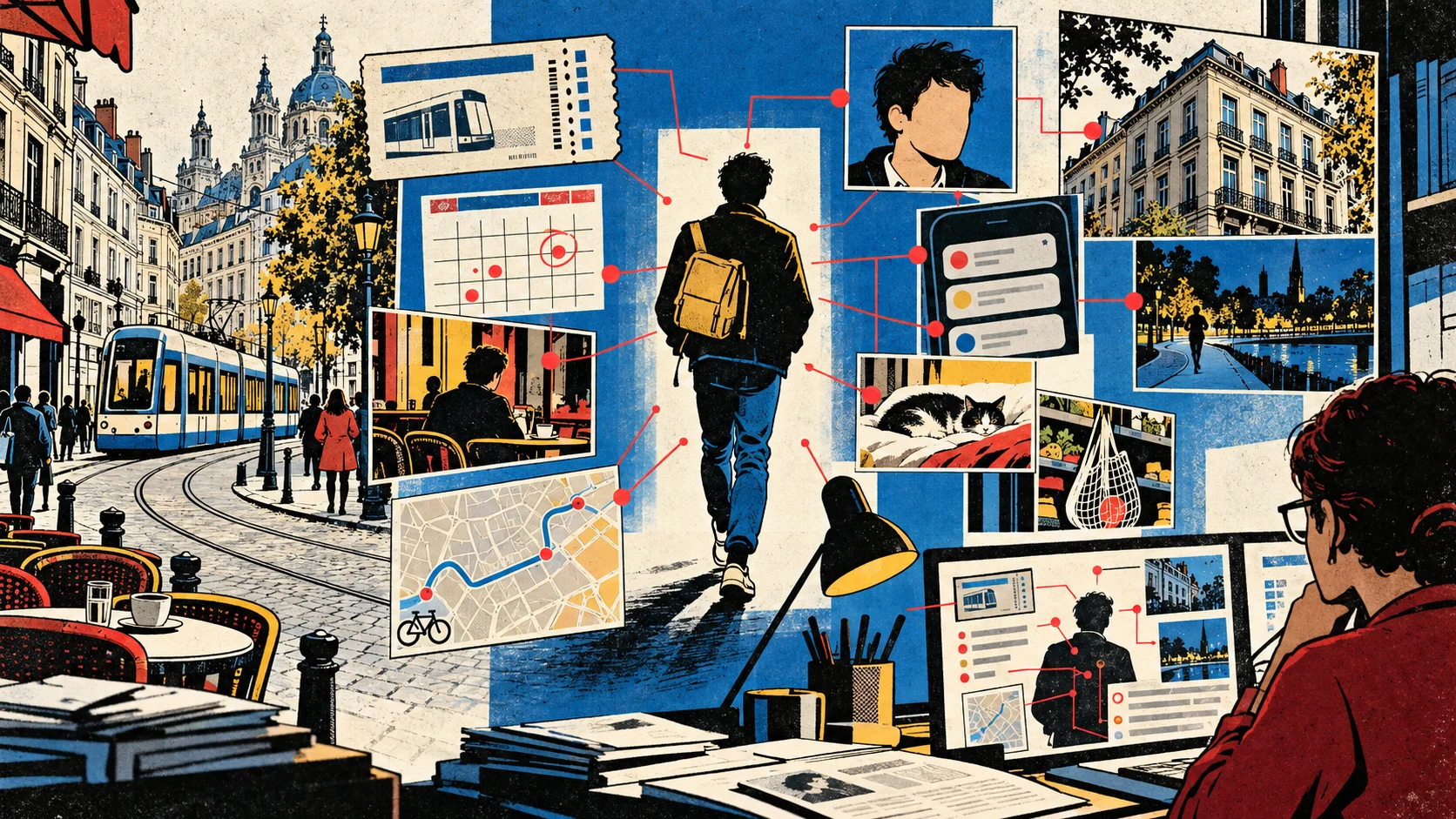
In this article
Until recently, building a digital portrait of a stranger required method, languages, patience and a good memory. You had to search for an old username, compare photographs, read archives, reconstruct a timeline and tell coincidence apart from a real link. That work has not disappeared. But part of its cost has just collapsed.
An AI connected to the Web can now suggest queries in several languages, summarise years of posts, match usernames, extract details from an image and turn a heap of results into a coherent narrative. It does not necessarily have a secret database on each of us. Its power comes instead from its ability to bring together, very quickly, what was already visible but too scattered to attract attention.
This is a major shift. The risk is no longer reserved for public figures or for investigations with a substantial budget. An email address, a reused username, a few photographs and a professional profile can be enough to kick off a search. AI does not make OSINT infallible; it makes it industrial.
The machine does not discover your life: it cuts the time needed to read it
OSINT — open-source intelligence — is not about breaking into an account or penetrating a system. It exploits accessible information: websites, registers, social networks, articles, public documents, maps, images, videos and metadata. A human investigator remains better at understanding an ambiguous situation, assessing a source and sensing what does not fit. The machine, for its part, excels at repetition.
It can rephrase a name, test spelling variants, translate a query, spot the same interests across several platforms, sort dates and suggest leads. The decisive change lies less in some mysterious ability than in the compression of the work: dozens of micro-tasks that used to be manual are now chained together in a single conversation.
This automation also changes the scale. A highly targeted search used to take time and was therefore reserved for targets deemed important. Once it becomes cheap, it can be repeated for hundreds or thousands of people. The profile does not even need to be perfect. For a fraudster, it is often enough that it contains enough true details to make the next message credible.
An email address can be the start of a script
A study presented at USENIX Security 2025 tested agents able to start from a single email address, search for public information about its owner and then craft a tailored lure. The most worrying point is not the literary quality of the result: it is the automatic sequence from research to choice of pretext to personalisation.
In 2026, an experiment with 7,700 participants measured this effect on a larger scale. Messages personalised by language models almost tripled the click rate compared with generic campaigns. The researchers estimate the cost of personalisation at around three US cents per recipient.
That figure changes the economics of phishing. The attacker no longer has to choose between an industrial, unconvincing message and a costly hand-crafted operation. They can automate part of both: the reach of the first and the precision of the second.
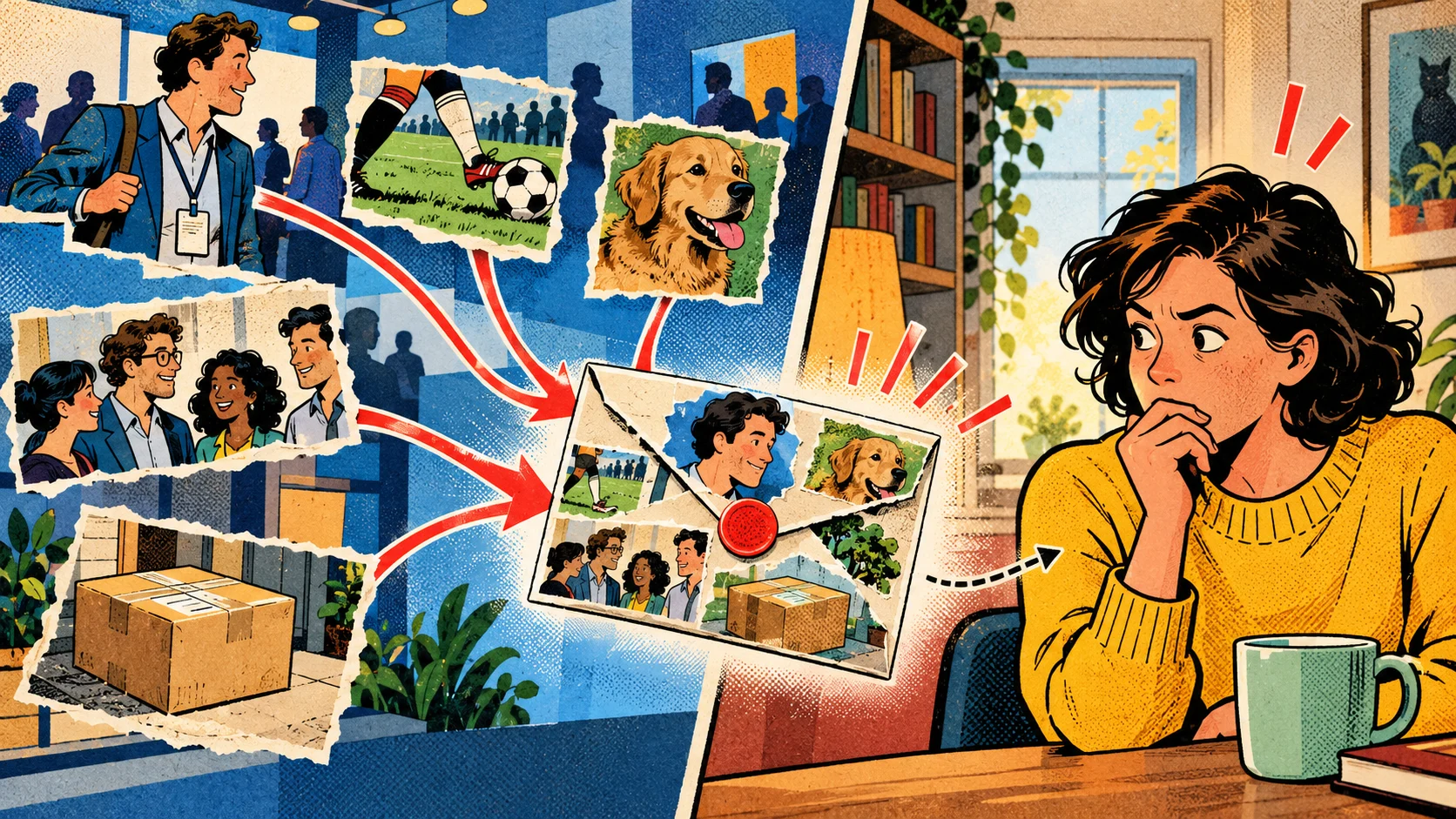
The message can pick up the theme of a conference the person attended, the name of a colleague, a hobby, a trip or a service they actually use. None of these elements is necessarily secret. Their combination nonetheless creates an impression of legitimacy: "someone who knows this must be the right person". That is precisely the mistake the attacker is after.
An ordinary photograph can work like a map
Geolocation illustrates this change even better. An image does not need to show a famous monument to contain clues. The shape of a window, the colour of a number plate, the brick of a façade, road markings, tram wires, vegetation, shadows or the model of a waste container can gradually narrow down the possible area.
Work such as LLMGeo has shown that multimodal models can combine this kind of signal on scenes taken in several countries. The tool then becomes a generalist able to draw, in a single analysis, on knowledge of architecture, botany, transport, climate and signage that a single human rarely possesses all at once.

There is, however, a trap to resist: a detailed explanation is not proof. The GeoRC benchmark published at ACL 2026 finds that some large models rival human experts at suggesting a country or region, but still invent clues to justify their answer — a non-existent inscription, misidentified infrastructure or an imaginary plant.
A location hypothesis must therefore remain a hypothesis until it has been verified by independent sources. In professional use, every clue must be observable, documented and reproducible. Without that discipline, AI does not produce intelligence: it produces a convincing story.
A false dossier is sometimes as dangerous as a true one
Automatic synthesis adds another weakness. By linking usernames, schedules or relationships, the model can reveal a real pattern. It can also merge two people with the same name, attribute a photograph to the wrong account or turn a correlation into a certainty.
For the person targeted, the error is not necessarily reassuring. A dossier made up of 80% accurate facts and 20% inventions can be enough to steer a fraud, a harassment campaign, a hiring decision or an accusation. The smoother the presentation, the more likely the reader is to forget that the text summarises sources of uneven quality.
Three layers must therefore be distinguished: what is directly observed, what is cross-checked and what is merely inferred. A serious system cites its sources, keeps contradictions and expresses uncertainty. A consumer chatbot, on the contrary, tends to smooth over the gaps to deliver an answer that is pleasant to read.
The same tool serves investigation and attack
A journalist can use these capabilities to trace the origin of an image. A security team can map its organisation's public exposure. An individual can audit their own footprint. The same functions can be used to prepare an impersonation, spot a routine or choose the pretext for a fraudulent message.
The difference lies in authorisation, purpose, proportionality and the handling of data — not in the tool. That is why the safeguards built into models cannot solve the problem on their own. A seemingly harmless request may be part of a legitimate investigation or a hostile operation; a refusal can sometimes block the professional without stopping an actor who has another model or a specialised service.
The UK National Cyber Security Centre considers that AI is already improving victim reconnaissance, social engineering and the rapid processing of stolen data. Above all, it expects an increase in the efficiency and volume of existing techniques, rather than the sudden appearance of an entirely new attack. Europol reaches the same conclusion: generative models make scams better tailored to the target's cultural context and personal information.
In other words, the nearest danger is not an all-knowing superintelligence. It is an old fraud that has become more attentive, better written and much cheaper.
Auditing your own digital reflection
Reducing your exposure starts with an inventory, not with panic. The goal is not to disappear — an unrealistic promise — but to understand which pieces can be put together.
- Search for your name, its variants, your usual usernames and the email addresses you use publicly. Do so in the relevant languages and alphabets, while logged out where possible.
- Look at the results as a stranger would: do they make it possible to link home, job, social circle, schedules, travel, hobbies or periods of absence?
- Check original photographs before posting them. The background, a reflection, a number plate, a badge, a parcel or the view from a window can be more revealing than the main subject. Remove location metadata when it is not needed.
- Avoid reusing the same username and email address everywhere. Separating professional, administrative, commercial and public use limits automatic cross-referencing.
- Close old accounts, correct outdated profiles and request the removal of information that no longer has any reason to be public.
In Belgium and the European Union, the right to erasure is not absolute, but it offers concrete levers. The Belgian Data Protection Authority explains delisting and recommends contacting the publisher or source first, then the search engine. Delisting does not always remove the original content; it does, however, reduce its visibility when someone searches for your name.
It is worth repeating this audit. A deleted result may have been copied, a platform may change its settings and a new leak may link elements that were previously separate. Protecting your digital identity is ongoing maintenance, not a one-off spring clean.
Stop judging a message by its grammar
Glaring mistakes are no longer a reliable filter. A fraudulent message can be perfectly written, adapted to the recipient's language and enriched with accurate details. The right question is therefore no longer "does this message look professional?" but "was this request expected, and can I verify it elsewhere?".
An urgent request for a payment, document, code or login must be checked through a channel you already know: the official app, a saved number or a separate conversation. Do not reply to the message to ask whether it is genuine, and do not use the number it provides. For sensitive requests between relatives or colleagues, a code word agreed offline can also prevent a convincing imitation from being enough.
Enable multi-factor authentication, starting with your main email account. Safeonweb recommends 2FA, separate passwords and a password manager. If you receive a suspicious message, the Belgian platform advises not to follow the link, to verify via the official website or number and to forward the message to suspect@safeonweb.be.
Organisations must protect context, not just accounts
A company can secure its email while publishing the organisation chart, suppliers, travel, projects, signatures and habits that make an impersonation credible. Reducing risk does not mean abandoning all transparency. It means examining what several publications make it possible to infer together.
Teams should map the information exposed for each role, include genuinely personalised scenarios in awareness exercises and require independent verification for payments, changes of bank details, data exports and urgent requests from executives. Public directories should reveal what is necessary, not serve as a ready-made database for targeting.
They must also govern their own use of AI. Pasting a list of employees, a customer file or data collected during an investigation into a consumer service can create a new disclosure. A defensive audit is still data processing: it needs a purpose, a scope, limited access, a retention period and human validation.
What really changes
AI has not abolished anonymity overnight. It has made it much easier to assemble fragments that internet users, their relatives, their employers and their devices were already publishing. Its strength is not that it knows everything, but that it knows where to look, what to connect and how to present the result convincingly.
This nuance leads to a more realistic defence. It is not about giving up any online presence, nor about believing that a button will erase the past. It is about reducing unnecessary bridges between our different lives, verifying requests rather than their style, and considering each post not only for what it says today, but for what a machine will be able to infer from it tomorrow.
Editorial information
- Written by
- Jeremy Kraft
- Last reviewed
- Method
- Public sources, editorial review and proportionate guidance.


Discussion
Comments
No comment yet. Feel free to open the discussion with a question or your own experience.